
Slopaganda: The Inauthentic YouTube Network Selling Secession to Albertans
Information Incident
Last updated: April 21, 2026
Key takeaways | To explore the data yourself | Context & incident assessment | Concluding remarks
Key takeaways
A network of inauthentic YouTube accounts is targeting Albertan audiences, exploiting genuinely-held grievances and repurposing them to advance narratives that normalize the prospect of secession and U.S. annexation.
These YouTube accounts perform an Albertan perspective, but we find no evidence to suggest any of them are. The AI avatars or paid American voice actors featured in these videos frequently mispronounce, miscontextualize, and misunderstand the politics they cover.
These videos contain frequent and obvious lies, drawing on real news stories to reach exaggerated conclusions designed to exploit political divisions.
We cannot confirm this network's origin or intent, and the available evidence is inconclusive on both counts. The potential scale of a daily political operation targeting Albertans and Canadians nonetheless compelled us to publish these findings without delay.
Context & incident assessment
Alberta secession is a prominent topic in Canadian news, driven in part by a petition campaign for a referendum in 2026. Online, Alberta secession inhabits its own distinct social media ecosystem. Many figures of the movement have large X and YouTube followings, with other highly followed, sometimes anonymous, accounts on platforms like Instagram and Facebook. Social media conversations can be difficult for the public to navigate, as democratic discourse is often interspersed with financial interests and covert influence campaigns.
We have focused on YouTube for this research because of the presence of a network of 20 inauthentic channels boosting Alberta secession and U.S.-annexation. We commend prior journalism by Colleen Hale-Hodgson and research by the Digital Forensics Lab on the topic and build on their work. This pattern is increasingly being referred to as slopaganda due to its low quality, highly templated approach, made easier by generative AI technology, to push political objectives through lies and exaggerations.
These channels use a mix of human actors as well as AI generated voiceovers and avatars to deliver the scripts. Where human actors are featured, it is clear they are not the original creators of the content, as they regularly mispronounce, miscontextualize or misunderstand what they deliver. Despite this, they often present as authentic Canadians and Albertans, using language that implies that they are integrated with the secession movement and passionate about the cause.
Because these channels offer no identifying information to real humans or organizations, nor ties to the secession movement in Alberta, we are flagging this phenomenon as a potential covert influence operation. The only person we can identify from these channels is an American voice actor based in Pennsylvania, almost certainly not the organizing force behind this phenomenon. We are concerned about the content that is deliberately inauthentic, produced by unknown actors pursuing unclear objectives.
Freedom of expression is a critical value to Canadians, one our research is committed to upholding. Advocacy for independence and sovereignty, whether from Quebec, Alberta or elsewhere, falls within that space. Our goal is to equip Canadians with the knowledge to navigate the online news ecosystem and ensure technology serves democracy. In that spirit, we believe Albertans and all Canadians deserve high quality, authentic, and fact-based news journalism. Albertan voices matter the most on topics relating to Alberta. And survey data collected by our centre earlier this year demonstrates this. Figure 1 shows the results of a question we fielded in February, 2026.
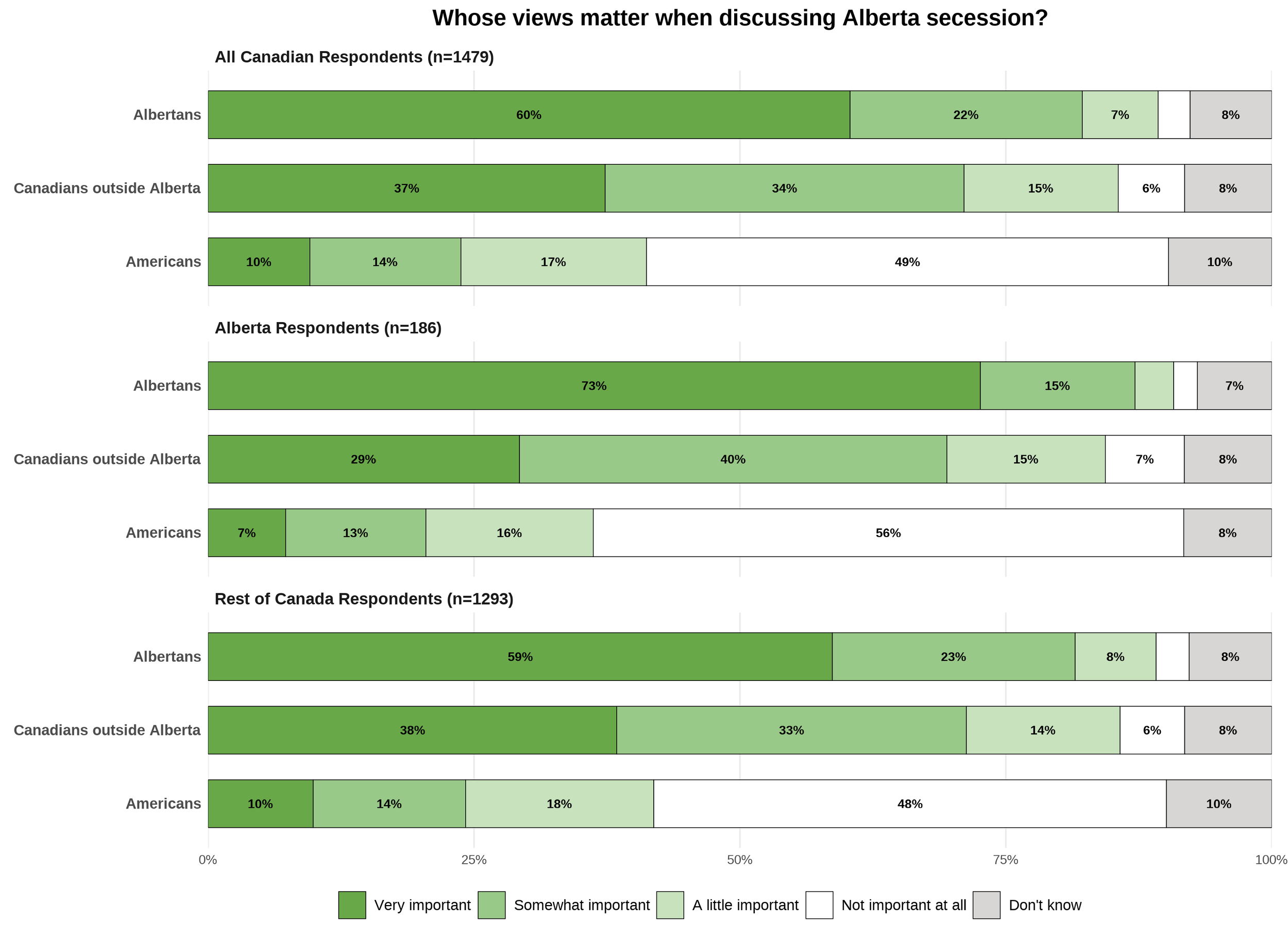
Figure 1. Whose views matter on Alberta secession? Weighted responses to “How important is it to consider the views of the following groups when discussing Alberta secession?’’ MEO/Leger online panel, February 2026. Non-probability sample; see Annex for full survey methodology.
Concluding remarks
Our goal is to equip Canadians with the knowledge to navigate the online news ecosystem and ensure technology serves democracy. We think Albertans, and all Canadians, deserve high quality, authentic, and fact-based news journalism. This incident presents a real concern to the integrity of the Canadian media ecosystem. The channels analyzed have accumulated nearly 40 million views in the past 12 months. For context, the Tenet Media YouTube channel, a Russian-funded covert influence operation exposed in 2024, also accumulated 15 million views over the course of a year, though the origin of the present network remains unknown.
Alberta secession is a major political issue in 2026, with a potential referendum being held in October. We hope this research sheds light on the incident and equips civil society, governments, and platforms with the tools to respond accordingly. We call on YouTube, and social media platforms more broadly, to take seriously this abuse of the public sphere and strengthen their responses to inauthentic networks. Specifically, we call on YouTube to:
Disclose geographic audience analytics for flagged channel networks so that researchers can determine who is actually watching this content;
Provide transparency into whether paid promotion or ad targeting was used to direct content toward specific regions;
Share information about the account creation and ownership history of channels identified as part of coordinated inauthentic networks;
Extend community notes to YouTube so that viewers can flag misleading content directly (a feature that could immediately surface the fact that channels like Canadian Reporter are operated by paid voice actors rather than Canadian journalists); and
Give accredited researchers API access to comment-level timestamps, account ages, and cross-channel posting patterns sufficient to distinguish organic engagement from coordinated activity.
Important questions are raised by our research and we are limited in our ability to understand the origins, scope, or purposes of this inauthentic network without platform cooperation.
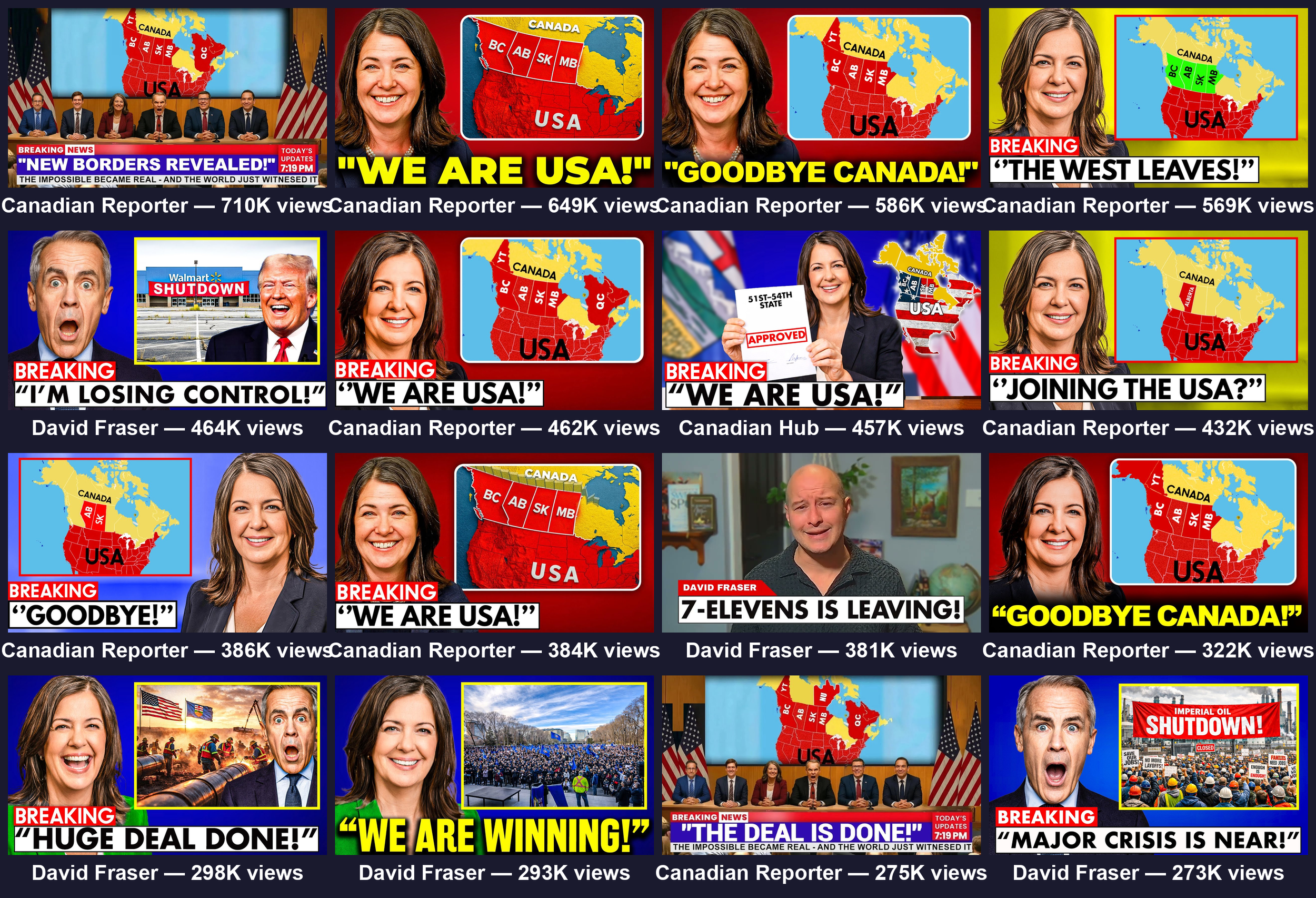
Background image: Thumbnails from inauthentic YouTube accounts.